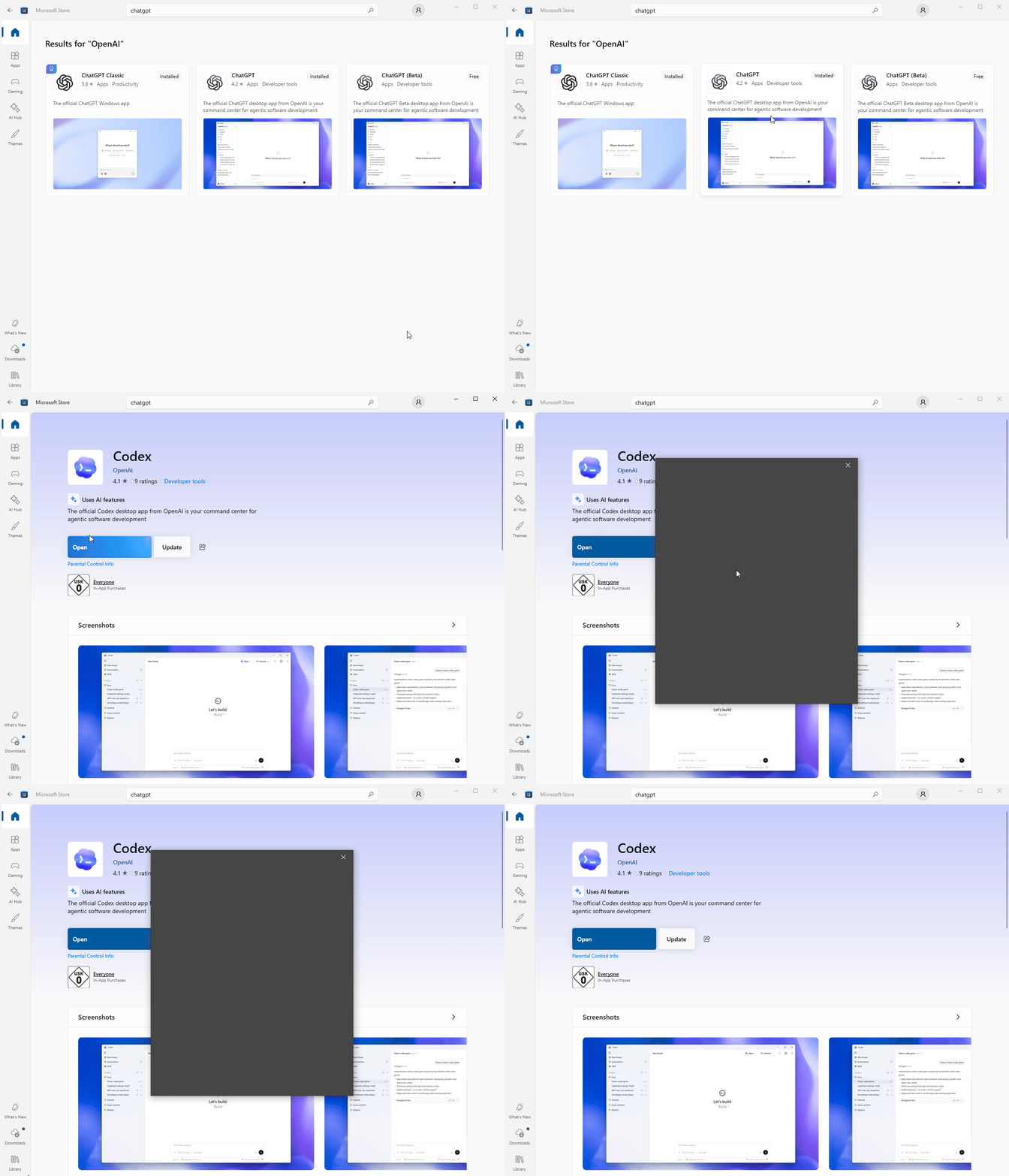
I just installed this. I am very confused. I no longer have a Codex app on my computer. ChatGPT is now Codex.
But what happened to ChatGPT? Where am I supposed to casually chat?
Also, when you toggle btween ChatGPT Work and ChatGPT Codex, nothing changes. This is super confusing. Can someone from the OpenAI team clarify the difference btwn the modes? Does chatgpt work have more business-y related plugins turned on by default?
Edit: So it seems like the only place you can actually chat with chatgpt is in an awkward homeless nested window. idk. The chatgpt interface wasn't great (desperately needed artifacts), but I still used it a lot. I can't see this change going well with a lot of the casual users.
Edit2: In their awkward homeless nested chat mode, you cannot even edit past messages. this is a mess, why was the team so zealous to pull the switch on unification in this state? guessing there was internal pressure to juice codex's growth but, based on what im seeing, they did it by torching chatgpt?
Edit 3: Ok so it seems like ChatGPT is still around, but renamed to "ChatGPT Classic". Seems like it wont be long for this world because there's no place to download ChatGPT Classic should you choose to uninstall it. The dmg at https://chatgpt.com/download/ only contains the new ChatGPT.
1) If you have the Codex desktop app installed, and you update from within the app, it replaces itself with the new chat-demoted-to-an-overlay app called "ChatGPT" and renames your existing ChatGPT app to "ChatGPT Classic."
2) If you get the new ChatGPT app and replace your current app with it, you don't get a "Classic" app and there's no way to download it.
3) They really named an app "Classic." Naming your app Classic is putting a bright red sign on it that says "this app will be abandoned soon." They might as well have called it "ChatGPT Sunset."
If this is all true, that is certainly...one way to do product management.
The best way to access ChatGPT "chat" was always on ChatGPT.com via a web browser, not even the iOS app seems to have all the little things you can do on the web version.
The Mac desktop ChatGPT app had weird issues like not being able to see the model being used by a chat inside a project etc. I just ended up installing ChatGPT Atlas and using that as an AI-only browser for all LLMs including Claude and Grok lol
It really is a mess. An hour or so ago, the download for macOS was called ChatGPT.dmg. However the app in there was still called Codex. But it installed ChatGPT.
But it seems to be fixed now.
Also, subtitling Work with "For getting work done" and Codex with "For developers" is a bit aggressive towards developers ;)
Sad, I liked that ChatGPT had a native app on macOS. I don’t understand why OpenAI and Anthropic have to rely on vending universal apps when their whole MO is code being dirt cheap.
Because there is more competition to render sites in a pleasing way, switching cost is lower. The operating systems have a high switching cost, very few people will learn a new OS because the text is a little fuzzy.
I look forward to John Gruber’s screed on this given his recent rampages against Electron apps, and his preference for OpenAIs native macOS app (relative to Claude).
Technically I think it uses something called OpenAI OWL not Electron https://openai.com/index/building-chatgpt-atlas/ (which they extracted from Atlas, but the new app mentions it in the about window)
>Also, when you toggle btween ChatGPT Work and ChatGPT Codex, nothing changes. This is super confusing.
This is the weirdest thing. It's completely unclear even if I was using the app for "work" rather than "coding" why I wouldn't just use the "Codex" option. Why even bother toggling? Can Codex actually not do any of the things in "Work"?
I feel like the web is under attack. They want chatgpt in desktop app so they can start moving people away from chatgpt via web. Web being suspectible to automation is driving everything into locked down apps. The very toxic reddit.com a prime example of this -- forbidding mobile web access behind a timed wall.
whether i use the new "chat" button that just appeared after the update, or use the familiar chat underneath the "projects" heading, everything appears to be working just fine. (i am using "ChatGPT Work" not "ChatGPT Codex")
Seems the old ChatGPT is still on computer but renamed ChatGPT Classic (no longer downloadable), so clearly being deprecated. But just don't understand how the whole CHATGPT Chat History Chat feature is essentially gone other than seeing at the past 3 or 4 in a tiny popup window. Glad everyone is as confused as I am, so hopefully an announcement from ChatGPT clarifying all this.
So will the new ChatGPT (Codex) refuse to respond at all after the 5-hour quota or weekly quota is used up? It always felt that 5.5 on the website was a lot more generous than the Codex version. And at least the website/old app could downgrade you to a lower model if you used up that quota.
The only difference I can see is that the controls for local/remote, branch, and worktrees disappear, and instead it shows office suite plugins. I would presume it affects the system prompt in the background?
Very confusing. But I do find it potentially interesting to treat general office work no differently from coding, which is something I had already been using Codex for in many ways before today
Codex creates a new folder in `~/Documents` in iCloud drive/OneDrive for every single thread you make. Furthermore, these threads are also polluted with your global AGENTS.md file, as well as all other developer_instructions that are injected by the harness.
Lol what a shit show. It was fine the way it was. Why'd you break it, OpenAI? What product manager talked you into thinking this was a good idea? Don't they have access to ChatGPT to talk them out of it? Of course, I'm a random on the Internet who doesn't get it, but what a dumb move. ASI can't come fast enough.
> Even though it says Work or Codex or whatever you can just ask it whatever you want, and it will work.
No it's not. Codex creates a new folder in `~/Documents` in iCloud drive/OneDrive for every single thread you make. Furthermore, these threads are also polluted with your global AGENTS.md file, as well as all other developer_instructions that are injected by the harness.
This unification is garbage. Chats that are about topics other than programming projects are relegated to a tiny, unsearchable popup window. Renaming the old app "ChatGPT Classic" implies that it will be discontinued at some point. This is a serious regression. What existed before worked fine.
I would expect the mode switcher to include a Chat mode, which would recreate the old, chat-focused UI, for asking about random topics. So, that's basically gone now. Technically, it's hidden and severely castrated.
I hope someone from OpenAI reads this. You guys have made a serious design mistake. I suspect you'll be getting a lot of support requests along the lines of "Where did all my chats go?"
I noticed the same thing. In the app, normal “Chat” threads are only available via a “Checking recent chats” window, while projects, GPTs, library… are completely absent.
The web version of ChatGPT is confusing too. Now it has separate “Chat” and “Work” tabs (what about a Codex tab?), and it shifts the burden on the user to know when to use one or the other. Note that using the “Work” tab means using Codex usage limits [^1], but that’s hidden away in the settings.
Also, apparently “GPT-5.6 Terra and GPT-5.6 Luna are not selectable in standard ChatGPT conversations” [^2] — so if you want to use these models, you must go to the Work tab or download the app.
I don’t understand why there is so much fragmentation in what was supposed to be a unified app. The way that it is now, it’s far from intuitive.
I agree. I'm not even sure what the solution is (it's admittedly complicated given how people use ChatGPT today in so many different ways) but it certainly isn't this.
And this comes from someone that has most chats inside Codex, so I should be the least impacted by this!
It's interesting how OpenAI at the same time pioneered chat as primary interface for LLMs (+ have one of their strongest brands and defensibility for the common user there) and also seemingly wanting to steer away from it in so many ways.
It needs design work but the unification is great because now ChatGPT chats are usable. With ChatGPT Classic and web, my threads are unusably slow - multiple minutes of 100% CPU just to reopen a session, and a minute long keyboard lag to type. (I have long sessions with artifacts and code etc.)
Anthropic just changed their web interface yesterday to have Chat versus Cowork as well, and every time I look at it, I'm so confused. I'm still so unclear when I'm supposed to use one or the other or the other.
Now the 'ChatGPT desktop app' (the Codex app, renamed) also has the split between work and code, and as far as I can tell, all it does is change which plugins are loaded by default to include Office ones when you put it in work mode. Perhaps it also changes the system prompt slightly?
Not sure if the cause but there’s this overarching absolute neglect of UX. Maybe they’re all just trying to grab as much market share as humanly possible, but imo it seems more likely they’ll lose each segment to products that actually make sure the experience isn’t absolute dog shit.
This thread is so spot on but I can also imagine the product development internally is moving so fast that they're trying to reconcile everything and can't. And this is the huge mistake so many companies make. Leave what's working alone. Build new adjacent things. It's clear they want to make money and work or code is the focus of enterprise. But never rename something Classic...so bad.
So my understanding of the differences between chat, code and co-work; but may well be wrong!
Chat is the human, talking directly to the LLM - old school. Very basic can create docs etc - but saves in a temp folder. No real access to your local PC.
Cowork / work - Human talking to an agent, which can then use tools to do work. Also runs in a container, allowing it access to your drives/computer.
Claude Code / Codex - No longer in a container, full access to the computer, depending on what permissions you give. No longer locked in a container. + The agent is more focused on coding than cowork / work.
> The agent is more focused on coding than cowork / work
I suspect this difference is pretty minimal. Before Cowork launched I was using Claude Code in the way that I use Cowork now and getting pretty much the same results albeit without the sandboxing (which is more of a hassle than not, TBH). OpenAI says in their announcement that the same is true for Codex, which doesn't surprise me at all.
These agentic loops are pretty applicable to all kinds of tasks, not just coding, and people started realizing this pretty quickly upon their introduction / creation.
I don't know why you're downvoted. This is field is so rapidly changing and confusing and on top of that burried underneath a shitload of new marketing terms.
I've loved using Cowork recently for sourcing decisions. Things where seemingly everyone's out of stock or questionably reputable, just let Cowork spin for 20 minutes, find the best new and best used options that meet your requirements, probably also suggesting a different item that does the job and is available for cheap. I've done it enough that I'm starting to loathe clicking through these sites myself.
The capabilities are useless if you don't expose them, and a cli or api doesn't. You'll mention their marketing page keeps talking about finance, sales, management etc...
In my experience, claude cowork has been pretty much useless. for the desktop control, it just seems like the The accessibility stuff is just not there yet on macOS to support it.
I had switched from Claude Cowork to OAI Codex a month ago. This seems like a rebranding and app merging to make it more obvious. And switching between the newly named "ChatGPT Work" vs "ChatGPT Code" mostly just seems to increase the verbosity of technical outputs, while using the same harness underneath.
I switched because Cowork felt like a bunch of features thrown in by engineers without thought to the UX. Codex solved a lot of those issues for me
- remote control from mobile has native approval dialogs, and you can start new threads from mobile
- you can remote control from another laptop
- computer use doesn't hijack my computer from me because it uses a11y trees instead of screenshots
- it was super unclear which skills were accessible to which surface (claude chat, cowork in app, code in app, code in cli).
- codex chooses the right browser profile and gets stuck less often than cowork + claude-in-chrome. I know there are 3P skills to use playwright or the chrome CDP, but I've found the native browser use most productive even if slower.
A few people here are missing the old ChatGPT app, but I found myself increasingly using Codex for casual chats too, and never using ChatGPT. You never know when the conversation might evolve to requiring tools in Codex, so no real downside to it. Yes, separation of work and personal accounts, or connecting multiple google accounts, is still unsolved on both Codex and Cowork AFAICT.
For a bit, I got FOMO because of Fable, but now it looks like 5.6 might continue the monthly model leapfrog pattern.
I think these kind of semi-coding agents--but hosted--are the future for enterprises. Claude Tag, Claude Cowork, now Work by OAI.
Agents-on-your-machine clearly have their place, but for many workflows this is too unruly. Hence, the "long-running agent running on shared infra" pattern.
I think this is where the ball is headed. I'm building towards an open source version of this[0]. Still just working on the core, but hopefully soon self-hosted versions can be built on top.
I came to the exact same conclusion recently. I am building something like lightspeed that can run on “pay per second” infra like fly.io sprites because I wanted to have an open claw style agent but not have to deal with paying for another VM.
Nowadays, depending on the project’s complexity I either run just 1 sprite, several sprites, or in one case 1 permanent “CTO” VM (with a dedicated GH App identity) that specs work that a fleet of worker sprites pull and implement.
yes, basically people that want to host powerful, long-running agent runs not on dedicated VMs (although lightspeed can use those too), but on an abstraction layer above.
My thesis is that the right abstraction is durable workflow engines. And AFAIK, OAI also uses Temporal for their complicated hosted agent infra.
On one hand, this had to happen at some point. I feel the split between ChatGPT vs. Codex wasn't helping OpenAI.
Anthropic did it right from the beginning by unifying everything in the same application. From my perspective, Codex is much better than any other app, but for non-technical users they were still stuck in ChatGPT only, and "nobody" knew about Codex. Anthropic also did it better by putting everything under the "Claude" brand: Claude Code, Claude Cowork, etc. Compared to ChatGPT vs Codex. OpenAI seems to be trying to revert that unwanted split.
With that said, I share the sentiment that it's 100% unclear what's the difference between Codex and Work. Chats now are a second-class citizen of the app. Although the "Attach to task" feature of chats looks useful. Putting "Chats" below the "Tasks" section would have been much better.
This may end up badly. Most people use ChatGPT just for regular chats, and they are not used to "agentic" interactions. It may take people time to adapt, and you can definitely lose users during that transition.
This also seems to have indirect implications regarding pricing. Codex (and Work) consume credits. Chats were also limited before, but you could mostly use ChatGPT without thinking about it. Now people will inevitably use Codex/Work more, simply because that's what the UI shows them, thus consuming credits. This will force you to keep an eye on credits a lot more.
Others have mentioned that the old ChatGPT can't be installed any more. Only if you had it installed before, it now became ChatGPT Classic. However, you can still add the chatgpt.com page as a Web App. You'll need an internet connection to use it, but the old ChatGPT app wasn't working properly without internet anyway... so the overall experience may not be that different. I'd even say that, to me, the web UI has always felt more polished than the native app.
Been excited for Codex to fully merge into ChatGPT, like it already has on iOS and how Claude Code merged into Claude a while back. Assumed there would simply be an update for ChatGPT that added Codex like on iOS. But instead a new "ChatGPT for Work" app. Which is fine. Downloaded and it replaces the standard ChatGPT app, again fine an as expected, but when I open it I just see Codex essentially. In top left, when changing from Code to ChatGPT still not seeing all of my ChatGPT aka years of Chat History. Other than one a box that says recent chats that only lets you see the latest 3 or 4 chats and opens them up in a small window. Am I missing something?
I wonder why they haven’t simply continued to rebrand Codex as a general-purpose tool. ChatGPT Work is a convoluted name and continues the trend of having separate brands for separate things, what runs counter to OpenAI’s purported goal of unifying every workflow into a single “superapp”.
Worse still: what happens when your workflow involves both coding and general knowledge work? Are you expected to switch apps, or switch settings? To me, it sounds very confusing and inefficient, and not at all what I was expecting.
because every non-programmer hears “codex” and thinks that it’s for coding only - seems like a large hurdle to adoption. claude has been successful with cowork branding which makes sense.
Isn't Microsoft heavily invested? As one should know, Microsoft are experts at confusing and contrived naming with no connection to reality: Windows Home, Windows Home Premium, Windows Professional, Business, Premium, Small Business etc. Now it is Copilot: Copilot, Copilot Plus, Copilot 365, pretty and Copilot Copilot too, I guess. And ofc Microsoft points, the currency for Xbox. And yeah, anything is Xbox too.
I think they're grappling with the fact that their positioning needs to be as the operating system but they don't have a leg in currently and destabilising the existing OS players is a monumental task. So they're stuck with the super app direction that just doesn't make sense for how the future of AI UX is envisioned.
Most shamefully and bearishly, in the AI golden age developers and knowledge workers alike are still beholden to use whatever software is shipped to them, instead of whatever system they can build for themselves.
I just clicked "Upgrade" in the macOS Codex Desktop app and it relaunched with a new name, "ChatGPT". My existing install of the macOS ChatGPT app seems to have been renamed "ChatGPT Classic".
just commented ton Tibo's post; they should have made things clearer and told us if the macOS ChatGPT app was going away. So I could either delete it or not be surprised when it rolls into something else :(
Desktop app situation is truly a mess for the trillion dollar AI companies, OpenAI and Anthropic.
After updating codex, it disappeared and chatdpt was still the old version. So I downloaded the latest chat gct from the website and it just said: "Couldn't install ChatGPT"
So I had to open Claude which was just a completely blank screen to try and debug the installation of ChatGPT.
I agree that the new UX is confusing and ill-designed.
A UI is supposed to help the user develop a mental model for what's happening under the covers. But what's happening when you switch from ChatGPT Work to ChatGPT Codex? If I switch it while in an existing session, nothing seems to happen. Does that mean it did nothing? If so, why let the user switch it at all.
When I switch it in the new conversation state, the help text changes from "What should we build?" to "What should we get done?". As near as I can tell, the switch gives me access to different sets of tools. But does that mean that some tools are not available in both modes? Why? Why not let the agent access all tools and pick the one based on context? Why are you forcing me to choose up front? And what happens if I choose poorly?
I get that OpenAI is moving fast, but I feels like a single round of usability testing might have helped.
The resulting "combined" Codex + ChatGPT mac app is super confusing. I use the Codex app with my work account, but I liked the old ChatGPT app, which I kept logged in with my personal account, for my LLM chat needs. I guess I can just use ChatGPT.com, but this was a rather jarring change.
> The updated ChatGPT desktop app (opens in a new window) is available globally today for Mac and Windows, with Chat, Work, and Codex available to users on every plan, including Free.
> If you already use the Codex app, you can update it as usual and it will become the new ChatGPT desktop app. Developers can make Codex the default view when they open the desktop app and choose the Codex logo as the app icon. Desktop Codex projects remain accessible on the go through the ChatGPT mobile app. The existing version of the ChatGPT desktop app will be renamed ChatGPT Classic.
---
Edit: I just got the update – the new ChatGPT.app is 1.46 GB
Update after using the new ChatGPT.app for a bit:
Lots of old ChatGPT functionality missing:
  - No voice mode
  - No Deep Research
  - No explicit Search toggle
  - No Record mode (meeting summarizer)
  - No Canvas (good riddance)
  - No custom GPTs
  - Old chat threads are hidden (have to open a new chat, then click “See all” under “Recent chats” – or use the “Search Tasks…” function)
Does the new ChatGPT app still separate ChatGPT and Codex usage quotas, or does all usage now count against the Codex limit?
It's uncanny how much the job of "crafting contrived yet plausible scenarios to over-sell the utility of our service" has become such a critical part of AI vendor marketing.
It's probably been commented here before but I'll add my voice: they did NOT think this through.
If you're gonna try and make people use one app for everything, at least make it differently optimized between modes. And how are you supposed to chat with ChatGPT while Codex works on a technical task?! (once they retire Classic)
it's interesting to watch a bunch of iq-worshipping rationalists learn in real time that above some threshold greater intelligence does not matter much to people, except insofar as it allows them to spend less time doing the thing they hate: working, that is, any activity where the whole point is to be done with it. most of life is not like that. work is like that. so work is where greater [1] intelligence could in principle be valuable.
[1] to use this "greater" we have to imagine we live in the fantasy world where we can measure it in one dimension.
Wow, this is the worst update I've ever seen. Highly confusing and atrocious UX. Where are my chats? Where are my projects? Why do I get a window inside the ChatGPT app for new chats now? Why does switching between Work and Codex not do anything? Are both the same? How can a company like OpenAI mess up so badly? Unless I figure out a painful way to work with this, I don't see myself using this anymore.
EDIT 1: I just want a list of my chats. Insane how they butchered their app. Work sounds nice until yo find out that none of the plugins work for my apps and there 5 hour are usage limits like CC does them.
EDIT 2: This is trash. They buried chats so deep in the new app they're unusable now. The whole list is hidden, and yo can't search for chats anymore. Also my projects are gone on macOS. In the iOS app my latest project has become a pinned folder? A function that doesn't even exist in the macOS app.
EDIT 3: Managed to get the old version back using home-brew. OpenAI help pages say the old app should remain as ChatGPT Classic but it didn't for me and there is no download offered.
Not very thrilled mainly because I used chats for ad-hoc search queries. Now it's hard to reach. Not to mention private chats being removed.
Regarding "ChatGPT Work" vs "ChatGPT Codex" - In Work diffs are gone and in new chats there's a popup proposing creating docs or sheets. That's it I believe.
It took me a while until I found that you can switch between those two parts Work and Codex within the app on the left top corner when clicking on "ChatGPT Codex". And then - nothing happens. The old ChatGPT projects of my chats are gone, only appearing on the web. Wow, what a bad UX pattern.
I ended up going the with gemini to provide sota ai to my family in an affordable way. You could always make your chatgpt sub accessible to your family via discord with a bot that codex can produce in under 5mins.
They have this, it's essentially ChatGPT Business. And if you use an Amex Plat card, it's basically free (plenty of ChatGPT 50% off links going around, or at least there were a few weeks ago).
So I've now lost all my ChatGPT chats? Or did they hide them?
I see some of them, but the history is inaccessible??
Edit: I found them back in the 'classic' version of the app. Wildly confusing what is going to happen to the data there, chats, projects, custom GPT's.
This is going to be fun tomorrow when everyone at the company I work at finds out all their chats, projects and GPT’s are ‘gone’ after they ‘update’. And not a word about this switcheroo ‘data loss’ in their comms. Wow.
All models I’ve used have been exceptionally bad at creating a high level business oriented vision and strategy from various inputs. The output just feels like it can’t see past the next word, or render distance, misses the big picture and anything not specified in prompt or input context
This is true but I also find the opposite true: the model is highly dependent on the input/prompt, to the point that it can't think beyond it or about it.
ChatGPT Work: because what every enterprise needed was an AI that can write your quarterly report and also gaslight you into thinking the deadline was always next week.
Very interesting approach, however I wonder if the combination of Codex + Work in the same app makes sense? I could see a world where the technical needs of a developer are hampered by the overall superapp architecture. I guess we'll see?
Honestly, there's just no way I'm giving these tools broad access to my computer. Claude recently started bugging me that I hadn't configured it to be able to access my email, which like, fuck off anthropic. It just seems like a security nightmare and a dangerous level of trust to have in these companies. To me, it's like: here's a folder you can work in, and if you try to do anything outside of it you can fuck off because I'm uninstalling you. I just don't think it's worth dealing with things like potential identity theft or it doing something brain damaged to my data so it can search my inbox or summarize someone's overly-long LLM written email. I know some people run these things in VMs which is smart, but as soon as you give it any sort of network access or access to sensitive data it's just way too big of a risk vector.
Am I the only one who thinks this landing page is garbage? Funkily it feels like a long wall of slop. I guess you shouldn’t get high on your own supply.
I can get some useful results from codex at work, because I have to, except for when I don't. I accept that risk factor and compensate by reviewing _everything_ it spits out.
But we all know what coding is, in a very broad stroke manner, sure.
What does an end of month report mean? I automatically increase the font size when I send the spreadsheet to Paul. I review tickets and provide a meta write-up on Friday. Or maybe Monday, because Fred didn't get back to me until 5:30 Friday, and I closed my laptop at 4.
These are just little things, and they're repetitive, but each time, there's some little idiosyncracy. I have reservations regarding any piece of software being able to finesse that.


But what happened to ChatGPT? Where am I supposed to casually chat?
Also, when you toggle btween ChatGPT Work and ChatGPT Codex, nothing changes. This is super confusing. Can someone from the OpenAI team clarify the difference btwn the modes? Does chatgpt work have more business-y related plugins turned on by default?
Edit: So it seems like the only place you can actually chat with chatgpt is in an awkward homeless nested window. idk. The chatgpt interface wasn't great (desperately needed artifacts), but I still used it a lot. I can't see this change going well with a lot of the casual users.
Edit2: In their awkward homeless nested chat mode, you cannot even edit past messages. this is a mess, why was the team so zealous to pull the switch on unification in this state? guessing there was internal pressure to juice codex's growth but, based on what im seeing, they did it by torching chatgpt?
Edit 3: Ok so it seems like ChatGPT is still around, but renamed to "ChatGPT Classic". Seems like it wont be long for this world because there's no place to download ChatGPT Classic should you choose to uninstall it. The dmg at https://chatgpt.com/download/ only contains the new ChatGPT.
reply