The advent of SSD has been redefining moment in PC history. Earlier when friends or relatives complained about slow PC, solution offered was add more "RAM" which was not possible as "RAM" always kept evolving with tie up to motherboards.
But now my first suggestion for them is to go for SSD, which instantly fixes their old "slow" PCs. Thus eliminating the need to buy a new PC/laptop.
All in all I feel that the market is basically seeking equilibrium.
For years, you had to buy at least a laptop if you wanted your mother to be able to use facebook to stay in touch with the family that maybe moved away.
Even back then, for such a usecase a laptop was overkill. But it was still a sale for the vendor.
Now, phones and tablets cover these things very nicely so it is only logical that sales of laptops decline.
What also helps explaining the lower sales is that quite frankly, for many many usecases where you might prefer a laptop over a tablet, a laptop from a couple of years ago is still very much sufficient to get the job done. There is simply no need to upgrade as frequently as we did in the past. Edge cases like heavy duty movie editing or rendering of course still require a more up to date machine, I imagine.
There's plenty of life in the PC platform. When you'll want to have high quality VR at home, it won't be on PS4 nor on Gear VR, it will be on a High specs PC with an Oculus or Valve headset. So not sure where you see this as an ongoing decline, when new uses are on the rise.
EDIT: besides, based on your link, it should be classified as Mature Phase and not Declining phase. See sales numbers.
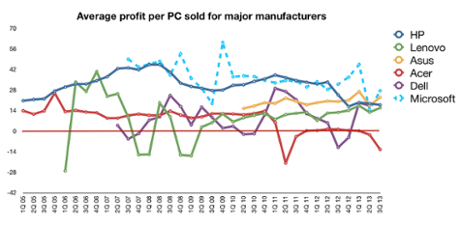
First, we're talking about laptops not all PCs. Second, the chart is of profit, not sales volume -- the number you gave. If you have not grown your sales by a rate that is at least in line with economic growth, you're in decline. The term describes a simple economic fact, and is correctly used.
You're upset because you see some kind of conspiracy to defame the PC or whatever, but the industry has not grown in sales while the economy has.
Jesus you are desperate to prove something here aren't you?
This is a chart of per PC profit. Let's break that phrase down:
"per" -- this says nothing about industry-wide profit, which you would need to address in a discussion about whether or not the industry is in decline. If I said that profit-per-telephone for rotary phones was the highest ever this year, would you be convinced that the industry is doing better than ever?
"PC" -- not just laptops. This graph goes all the way back to 2006, when laptops were hardly as ubiquitous as they are today.
I don't understand what you're trying to do here. The industry is clearly in decline by every accepted measure. Even if we go by your chart, any industry whose major players are doing worse than (or at best, about even) with their numbers from 8 years ago would be said to be declining. Not stable, which is another term with a specific meaning, and also not what you think it is.
> The industry is clearly in decline by every accepted measure
Feel free to find data showing "clear decline". I'm saying I'm not convinced. It's about as much in decline as anything else that's needed in every life : cars, fridges, stoves... PCs are now commodities, what's the big news ? This means low profit margins, and this means low renewal cycles too except for niche uses. Yet we aren't going to see the sales drop by 50% anytime soon.
Oh if you don't believe it, I don't care. It's only my concern that you not make a dumb case against the word "decline" based on a common sense parsing.
Yet we aren't going to see the sales drop by 50% anytime soon.
That's just one article. You can try googling "laptop sales year over year" and seeing what comes back. Nobody who knows anything denies that the industry is in decline.
But then again, HN's cadre of Ron Paul voters are known to deny basic economic realities based purely on wishful thinking, so you're hardly alone.
If you are looking for a Linux compatible laptop that is somewhat similar to MacBook Air, look for Asus Zenbook UX* line. Excellent display, good but not awesome battery life, fast hardware and really good keyboard for its size. I've bought two UX31A's, one for myself almost two years a go and one for my dad last Christmas. Everything else works straight away with Ubuntu other than ambient light sensor. I think there isn't any workarounds for that.
I got Lenovo X1 Carbon (2014, Touch) from work couple months ago and while it has better CPU, bigger SSD, more RAM and better GPU than my two year old Zenbook, it's just worse. The Zenbook lid can be opened with one hand, Lenovo requires both hands. Lenovo has too heavy display and too light keyboard part combined with too tight hinges, so when trying to open the lid with one hand, the whole computer lifts up from the table.
Also, Zenbooks have normal keyboards. I hate the keyboard on X1 Carbon. Instead of normal function keys, there's are adaptive touch keyboard thingy that tries to figure out what kind of special buttons should be shown in there with each program, but it just fails. And feels like... well it does not have real buttons, so I can't feel a thing while using it.
Also, delete button is in the upper right corner in X1 Carbon. And backspace is on the left hand side of it. And that makes no sense. Backspace is used way more often than delete, so it should be easier to hit. And upper right corner is easier to hit than almost upper right corner.
And Zenbooks have normal arrow keys that are not too crowded. Lenovo decided to put page up and down right next to up arrow. When ever I accidentally hit page up or down instead of up arrow, I feel like I'm totally lost.
And almost forgot, Zenbooks have good touch pads, X1 Carbon touch pad moves up and down, so it's like a huge button. Really annoying when you just move your thumb on it and accidentally press too hard, so it registers a mouse click even tough you did not raise your finger.
So, in short Asus Zenbook UX* laptops pack awesome hardware, work with Linux pretty much perfectly and have really good build quality.
Or just buy an older ThinkPad X201 / X220 / T410 with 1440x900 display and get a new 9-cell battery.
The things are really cheap, have a proper keyboard, are bomb proof, every part is replaceable for minimal cost, they are 100% supported by all operating systems, have excellent docking support and you can just sling them in your bag. Mine lives down the back of the sofa cushions when not in use.
I knackered the headphone port on mine from overuse. 5 mins on ebay, £7 spent, new board installed in 5 mins with a Philips screwdriver and the service manual.
For every day tasks, I use an i5 X201 with 8Gb of RAM and a Samsung 840 Pro and it's no different to the stacked HP Z620 I have in the office to use. If I need more power then I use that remotely.
Totally awesome machine and I paid virtually nothing for it.
PC tech is moving so slowly now it's a better investment to buy two older machines so you have a backup unit than one new one if you ask me.
I've always been curious--what's the use case for the backlit keyboard?
At the surface, backlighting seems largely aesthetic to me; I have muscle memory of my keyboard layout and do not need to reference the keys at all while in the dark. (A huge tactile cue is the TrackPoint in the keyboard.) I understand that there are lots of variables: not everyone uses their machine as frequently or may not have a keyboard amenable to this.
Does anyone here feel backlit keyboards are essential? Why or why not? What is the consensus rationales?
Anecdote. I had a 2011 MBP with backlit keyboard. Never used it once. In fact, the machine ended up with windows on it because MacOS made me want to smash the thing (despite being a Unix guy) and the Boot Camp drivers didn't switch the backlight off reliably which annoyed the crap out of me.
If you're sitting in a place dark enough to need it, it's not good for you staring at the contrast between the screen and darkness so turn the light on.
I never understood the turning the lights on bit I found bright ambient environments hurt my eyes more when trying to concentrate looking at the screen then dark environments.
Then again most websites I use regularly have been re-skinned to have dark themes since white hurts my eyes regardless of the ambient environment.
I tend to use the backlight on my keyboards to align my fingers and when searching for symbols.
I never felt the need to memorize where all the symbols are located since they change locations depending on keyboard type(language) anyway and i can't be bothered to.
Yes, I have the 2013 model of the X1 carbon and it's about perfect for me (running Debian). But I have no idea why they ruined the keyboard on the latest model.
Can someone please explain why Samsung isn't selling laptops besides the article's dismissive "It's common knowledge that the PC market is in decline."
Is it that they are spinning off their laptop division, or is there is some other dominant manufacturer? Why on earth are laptops not selling?
I agree with all the other posters, and believe performance and form factor have reached a point that makes frequent upgrades less common. However, I'll add one more point into the mix...
Modern computer specifications are confusing. Back in the day it was extremely linear. Oh, your computer is 233 MHz, this new one is 300 MHz, or 450 MHz, or 1 GHz. It was like owning a Supersoaker 2000, and wanting the newly released 3000.
Now, I have no idea what I even own. As someone else said, it's a dual-core something or other. There's no upgrade path, or direction for consumers to follow. If you walk into a store, it's quite confusing, and it's difficult to make sense of all the recent hardware, and I think it leaves people not knowing what they want to buy, or what's even considered an upgrade.
The model numbers manufacturers have definitely don't help. A friend recently bought an Acer Aspire E1, of which there are about a million different combinations. The range she got has model numbers like E1-472P-XXXX, where the last four digits mean "whatever configuration of components we plucked out of a hat". Her's is Core i5 4200U, 8GB RAM, 1TB HDD - which I can't find anywhere online :D
As another commenter said Apple has it right in that it's easy to say "this is the 2013 model". I bought a TV yesterday, and although they seem to have confusing model numbers too, at least the shop displayed them saying which was the latest models and it was easy to see the difference between them (apparently "dual core CPU" is a feature of TVs now).
In the UK at least if you walk into a store you will find they have a confusing set of badly specced models of brands you probably shouldn't buy at prices you probably shouldn't pay.
I give a lot of credit to Apple in keeping their line fairly straightforward (usually only devs or photo/video people need upgrades) otherwise everyone gets the same base model for one of a tiny number of variants. The prices across channels and concessions are always the same too.
It isn't that different though. You still look at clock speeds on the CPU, as well as the burst speed for what it can ramp up to. So that's the 233/300/450 comparison done.
Then perhaps look at whether it is i3/i5/i7 - the higher ones are better.
But then instead of just thinking that your processor is one CPU, count how many logical processors are in there: dual core, quad core etc.
It's still the same - the higher numbers are better :-)
Of course, other things to take into consideration (like it has always been) are FSB speed, RAM clock speeds, disk cache size, disk type, amount of RAM, GPU processing capability (use the same rules as the CPU - count the RAMDAC speed, the amount of RAM, the number of cores), and so on.
I don't think it's changed that much. Just there are more brand names and model names on things now, perhaps?
Not sure why I was downvoted for my comment above?
Surely you just look at the numbers for everything - higher numbers of cores, higher numbers of model numbers, high numbers of CPU speed, higher numbers for RAM speeds and capacity, higher disk speeds etc. etc. etc. etc. ???
Realistically, consumers choose based on the clear numbers, disk space and memory. 1 TB disks and 8 GB of RAM have recently hit the low-ish end of laptops so at least there's that to go on.
Basically, in my experience, Dell and Lenovo now rule the corporate market, while the consumer market is now 1) smaller (since tablets and smartphones cannibalized some of it) and 2) clearly split between Apple and "everything else", where "everything else" runs on thin margins and is perceived as cheap and uncool. My anecdotal datapoint is that, in the last 5 years, I haven't seen anyone in my sector (finance / IT in the UK) using anything but Dell, Lenovo or Apple laptops (with the very occasional Sony Vaio, which Sony recently stopped selling).
On a larger scale, the rise of smartphones and tablets has clearly shrunk the traditional PC market, a market that already struggled with the end of Microsoft-led forced upgrades (that "good enough" level others mentioned; Microsoft used to periodically redefine what "good enough" was, but their products have substantially fossilized in the last decade). This doesn't mean PCs and laptops will go away for good; it's just that large margins are now elsewhere, so the industry is adapting.
I recently saw a colleague with a surface pro (version 1) as a workstation, I was rubbing my eyes, because I couldn't believe that this is working.
That said, I'm now working (as a programmer, yes) from a Sony Vaio Multi-Flip 13". It has everything I ever wanted: Good resultion, sleek, quite remarkable performance for that tiny little thing, convertible, etc etc. It also "look good", as the apple devices do, and, in addition, you can flip it over to a tablet. Well... in theory the best thing that I ever had. In theory. The closing mechanism sometimes doesn't recognize a "is closed" properly and the notebook shuts down and comes up again in camera mode. I recently had to replace the keyboard, because the return key was broken, which is not easy with an ultrabook when warranty is over, since its soldered or brazed (or how you call that) with plastic pins. When I got it, I think I got a refurbished device, one key was stuck, and circumstances required that I open it myself and fix it and found the inside overwhelmingly full of fingerprints and screws in wrong places. I could continue like that and I am not alone. All these things, these little quality and qc glitches between an Apple device and "all the others" are (for me) the main reason why everyone runs to apple. They are producing just the best quality and for me as a consumer, its still affordable, and it even looks better and feels better. I am no friend of iOS, I grew up with windows and linux, which is no excuse not to buy an Apple, but I would still first look everywhere else for alternatives. So, that samsung is also shutting down is very sad, since they produces very nice models. A friend of mine has the older samsung series and has also quality glitches. Beside apple, it seems the market has realized it has to produce good quality, good looking and good functioning devices, but most of them are all show and no substance. For my understanding.
I was hoping they would slowly slowly introduce newer models, better processing, better overall quality. Instead they are shutting down. I'm sad.
One would think that there is at least some market for high end laptops. Whenever I look, I don't see much in the way of alternatives to the MPB though. That's partly because top of the line models are buried under a pile of 'deals' and other consumer junk.
Maybe there's an opportunity to put together a site that aggregates the top-shelf models from various manufactures with efficient filtering on features geared toward raw performance and build quality (shell materials, keyboard, etc.).
I'm a Surface Pro 2 User and a Software Dev and couldn't be happier. I only have to carry 1.1kg of Hardware around to have my full Workstation with me and when i'm in my office i've got a perfect Dockingstation. No fiddling with cables: https://fbcdn-sphotos-d-a.akamaihd.net/hphotos-ak-xpf1/t31.0...
Those are 2 older Korean Crossover 2560x1440 MDP Screens with Display Port. Technically the Surface Pro 2 is able to connect to both of them over its one Mini-DP Connector via DP 1.2 Daisy Chaining, but since those Monitors only support DP 1.1. i tried connecting them over the MSI Multi-Stream-Transport Hub, which didn't work reliably enough, the monitors weren't always recognized instantly and it felt to fickle to work with. The solution was an older USB3 DisplayLink DisplayPort Adapter. It works much better than I expected and I can dock and undock as often as i want without the configuration or drivers becoming unstable which was my main concern.
Monitor TL;DR: 2x 2540x1440 Monitors, one via Mini-DP, one via USB3.
There is only one USB3 Bus on the Dockingstation for the SP2 and sadly Microsoft has cheaped out on the Ethernet Port for the Dockingstation as its only 100mbit. (The Dock is only Connected via one USB3 Port, one Mini-DP Port and its Power Connector, so guess they wanted to save the usb bandwidth since most people don't need >100mbit anyway) As i've got a 1 Gbit Line (we work next to a server farm) at my office i didn't want to compromise on that too much, so i've attached an USB3 Hub with included Gigabit Ethernet Port which is hidden with all cabling under the Desk. With the USB Monitor switched off i get about 800mbit over the card, with the USB Monitor it varies between 300mbit and 650mbit, depending on what is going on at the Monitor at the time.
Network TL;DR: External USB3 Gigabit Adapter, between 300-650mbit throughput.
We're a JS and PHP Webdevshop mostly, so I run PHPStorm on it, often alongside Photoshop CC 2014 to review Designs. The hardware takes that beautifully, but i can push it towards its limits when opening 2-3 animation-heavy sites in Chrome with the debugger open. Thats the only performance painpoint that i'd like to see wiped out when i'll buy my next Surface, i guess when they roll out the 4th or 5th gen. I've also ran Eclipse on it for Android Development and again, no problem there aswell, so i would guess Visual Studio would run on it nicely aswell. Unity3D runs nicely to do quick prototypes, but its obviously limited to the graphics capabilities of the Intel i5-4200u it runs on, so its okay for a Game Jam, but I (obviously to me) couldn't recommend it as a professional GameDev device. I've got the top model with 512GB SSD since it's supposed to last me 2-4 years atleast, i'd just hope for 16GB of Ram so I wouldn't have any regrets when opening multiple browser VMs (IE6-7-8-9 in parallel running vms with 6-8 each getting 1gb of ram and 9 2gb makes it run sluggish aswell), but I didn't find that in any notebook under 1.5kg so I compromized on that with the Surface and am not disappointed.
Software TL;DR: PHPStorm & Adobe Suite run alongside beautifully, more graphics power would be nice, but i don't really need it. If you NEED to run >5GB RAM of VMs, this device isn't for you.
With PHPStorm in PowerSaving Mode it lasts me about 5 hours before I need to find a plug, which is okay but I hope it to improve in the next iteration I get.
Battery TL;DR: 5 hours.
I have an IKEA BEKANT electric standing desk[1] and the cables are all tugged tightly under it and out of the way. On the Desk I have the Google Nexus Wireless Charger [2] for my Nexus 5 and an Dyson Fan which i've got as an gift, wouldn't recommend it for being so expensive while just being a regular fan. I carry my Surface around in a small vertical messenger bag [3] which contains beside the Surface Power cable an Jabra Speak 510 portable bluetooth conference speaker[4], an Logitech R800 Presenter[5] and an EasyAcc Battery Pack[6] which I can charge with the integrated USB Charger in the Surface Poweradapter.
My whole setup is geared towards me being always ready to do intensive dev work while staying mobile enough to jump up and do sales or community management and the Surface fits that purpose perfectly.
I work for one of the larger corporations on the planet and in a recent presentation it was announced that employees will have a choice between a laptop and a Surface. Quote "our sales people are looking positively old-fashioned visiting their customers with laptops".
So, expect the corporate computer market to take a nose-dive in the next years too, I guess.
It's been going on for a few years. If you look at the level of performance improvements (intel chips have single to barely double digit percentage gains in performance per generation upgrade now, whereas they used to almost double in speed every two years) and at the installed base (good enough screens with good enough resolution, good enough SSDs or HDs with enough space) it just shows that the replacement rate obviously will go down. Back a few years ago you HAD to upgrade to keep up with innovation (audio files won't fit on a 40MB HDD, videos won't fit on a 1GB HDD, HD won't fit on a 32GB HDD etc, XP won't run on 512MB RAM, video compression/decompression will be better on a Pentium II than a 486 etc etc), but honestly what's the difference (to a non-developer casual end user) between say a gen 2 Core i Chip with 4GB of RAM and a 256GB HDD on a 14" 1400 px Screen compared to say a Haswell i5 8GB RAM, 256GB SSD, 15" 1920 px Screen machine. Nothing.
Tablets are facing similar issues. What'll be the big difference between an iPad Air and this year's iPad Air 2?
No doubt. Still using a 7 year old Core 2 <something> Thinkpad and it still works great. Resolution and speed are not a problem. Replaced the hard drive for a solid state, the fan at some point but otherwise I just don't see a good reason to spend another $1k or $2k on a new laptop.
I just bought a Lenovo x220 which is about 2 years old, and it runs both Win7 and Linux Mint perfectly. Very fast, and I can even do SOME gaming with it. Best 200 USD purchase ever. There's no clear reason to upgrade laptops every year, until then I was using a 5 years old HP PC, which was working fine, too.
Shutting down your PC line in Europe is stupid, though. Well, that's better for the other competitors, which will fill the gap.
PC sales (laptop and desktop) in general have been on the decline since 2010 or so and the margins in that market for players who aren't Apple are generally so low that the declines don't have to be that bad to really put a squeeze on manufacturers.
The iPad/Tablet market gets almost all the credit for this decline in the media but while I'm sure that's part of it I personally think the fact that we hit a point around 2010 where desktops and laptops were just plain good enough (truly good enough, not 640k good enough) for almost everything people normally do was as much or more of a factor than tablets. Short of having a machine die on you there are precious few reasons to run out and buy a new system anymore.
I'm a software developer, a hobby photographer who shoots in RAW and a gamer and even I haven't bought a new desktop or laptop in 4 years (and I used to be someone who would build an entirely new desktop system yearly with major upgrades 6 months in to boost it up).
Indeed. If you have a late 2008 all Intel laptop with a Penryn CPU and an X25-M SSD (fiendishly expensive at that time) to this day, six years later, it's hard to see what's the point of getting another laptop.
For a few more years, the decreasing costs of SSDs were giving incentive but yes, once you have that, what incentive remains? The high resolution screen is still more trouble than advantage.
I was purchasing newer and newer ThinkPads for a few more years, until I could put 16GB (for a sw developer, having lots of RAM is helpful) in a 14" model, then stopped at the T420 in 2011 and that's the end of laptops for me for the foreseeable future.
The substantial improvements in battery? Better screens (brighter, better fov, more resolution 2008 laptops had atrocious screens)? More portable designs? USB3? Better trackpads and keyboards? More durable designs?
If someone had the answer to that question then Microsoft, Sony, Samsung, etc. would be much, much happier. The entire PC industry has been shrinking for the last few years, sometimes with double digit declines. Nobody wants a heavy, hot, loud, and crappy laptop when a tablet like an iPad can do everything that matters to most people (email and web) and then some.
It doesn't help that (a) consumer Windows laptops have come so pre-loaded with junkware that they were just downright unpleasant (and often unreliable) to use, and (b) Microsoft dropped the ball so hard with Windows 8 that it fell through the earth's core and came out the other side.
Compare the extremely unappealing offering that is Windows 8 on a junkware-laden laptop with the convenience of a tablet for everyday consumption/casual gaming uses or a much more polished MacBook Something for more serious users, and it hasn't really been a serious contest for several years now. Plenty of people already had a laptop that was good enough for what they needed anyway, and most people looking to buy something new have dramatically more appealing options than the kind of thing Sony or Samsung were selling.
> Nobody wants a heavy, hot, loud, and crappy laptop when a tablet like an iPad can do everything that matters to most people (email and web) and then some.
Anecdotal counterevidence:
My mum is almost 50 years old. She has never been computer savvy. All she ever does is read email and browse the internets. Barely browse the internets. She uses her TV cable far more than she does internet.
Last year I bought her a tablet. One of those big fancy Galaxies with a stylus and everything.
Not six months later she started begging me to get her a computer because "This tablet thing is just so useless. I can't type (she got an external keyboard too), I can't tell which app I'm in, what I'm trying to open, and it's just so damn small. I don't like using this stupid thing."
She's been using it as her only computer regardless, but she's been complaining all along about how small it is, that she has to hold it up and a bunch of other things. This year I'm getting her a refurb MacBook Air. We'll see how that goes.
Weirdly, my mum used to have laptops for years, which she used for running at an obscenely low resolution, making it practically unusable.
She played solitaire on it, and used Facebook. And I think that was all!
She bought an iPad (finally) and doesn't make a fuss about not changing the font size (she can't, so she doesn't make a fuss anymore), and seems really happy with it. But she isn't trying to create things on it. That could be what's different with your mum.
As far as I know, my parents still have old-fashioned desktop PCs. They also both have an iPad. I don't think they have laptops, though. Maybe my dad does.
I should check how much they still use their PCs. My dad used to program a lot, and my mom moderated a mailinglist and was active in a bunch of communities (for some context: I'm 40, my parents are 68). Tablet usage is definitely more passive and consumptive.
ASK her before if she'd rather have an old 15" MacBook or an Air. If she's complaining about the tablet being to small, she'd probably rather have a larger screen than 13".
Samsung wasn't a big laptop or PC seller anyways. I think they are more interested in selling (relatively) high margin devices that they can control and market (like phones and wearables). It's not that PC market is in decline, as others have pointed out, Samsung sees more money elsewhere.
The killer features ended up being battery life and connectivity, exactly the areas where a traditional wintel laptop struggled. In contrast its primary strength was the enormous windows app catalog and that's been heavily mitigated.
I wonder if differences in implied warranty cut into margin in Europe.
It's not super clear what the actual standard is, but I know that (for example) a laptop that I had failed at about 13 months old because of a design flaw and in the US I was SOL, but other complainants with the same flaw in the UK had the motherboard replaced because the laptop was considered "not fit for purpose" which if I understand the Sale of Goods Act in the UK is good for 6 years after purchase — that could really eat into the margins in the hardware industry
In the EU there's a mandatory warranty of 2 years for all electronics.
At least in Finland, the "not fit for purpose" stuff also applies in addition to that so if you can prove that your hardware failed "unreasonably soon" because it's somehow defective and not just due to "standard wear and tear", the manufacturer has to fix it. Of course it has to be a very valid reason for that to apply.
The 6 year figure is an upper bound, and even if a device failed after 5 years the laws here in the UK wouldn't normally require a full refund of the original purchase price or anything so disproportionate.
However, there is a principle that essentially says something has to last for a reasonable length of time given what it was bought for. I think few would claim that a laptop costing hundreds of pounds and failing just over a year after purchase met that criterion, and that's what triggers the repair/replace/refund rules in the kind of situation you described.
As this seems a reasonable place to pose the question: I've seen (eg. at meetups) people using bluetooth keyboards with tablets turned around on stands as sort of mini-laptops with shell access.
Has anyone here done this with a comfortable hardware configuration for nontrivial developments tasks? I guess what I really want are tablets that run proper (vs. Android) Linux, can perhaps handle occasionally running paravirt at not entirely painful speeds, and (I believe this is the killer standing in the way) have hardware with open source or reliable enough binary blob drivers that are therefore safe to frequently deploy very recent kernels to without losing wifi, sound, camera, GPS, GSM/CDMA, backlight control, etc.
This happened in Australia as well and it really sucks. I run a 15" Series 9 machine and the only thing you can fairly compare it to is a Macbook Air. They're beautiful pieces of hardware somewhat let down by their crappy LCDs.
Any idea when this happened in Australia? It's not mentioned in the article and I remember seeing Samsung laptops in stores as recently as a few months back, but they do indeed seem to be gone from samsung.com.au.
In a similar vein, I feel that there's a sense that consumers feel tablets are "vaguely better." By this, I mean a number of things. For example, laptops often by and large are still sold with hard disc drives instead of solid state, and therefore tablets are actually a faster experience. tablet and smartphone UIs do a 'better job' at handling errors; by this I mean keeping redundant error message pop-ups to a minimum and attempting to more elegantly kill an app. An app store is a simple and safer place to download new software than the awful method Windows had going through the 90's and 00's of venturing out and downloading mysterious programs (which in it of itself has greatly damaged the Windows reputation).
I guess my point is that these issues are not inherently solved due to the tablet form factor, but rather better UI and more pointed hardware directed toward consumer use cases.
So now it's ThinkPad or MacBook Pro. What is it like to run Linux on MacBook Pros these days? Does Ubuntu and other popular distributions install without much fiddling? Does any of the hardware not work with Linux?
I second this. It means stuff typically just works (including that old chestnut hibernation), plus it means you can write OSX/iOS software still (which is why I bought one in the first place)
I thought Chromebooks were selling like hot cakes, then I asked the guy in Officeworks if they sold them and he said, "We used to, but not any more". And now Samsung are pulling their Chromebooks out of Europe.
It's beginning to seem a little weird when companies refer to either exiting or entering markets in various regions while remaining unchanged in others. Obviously this generally effects retail and not online sales.
The Samsung Q30, that many of you might know as the Dell X1 was a subnotebook so far ahead of its time. It was 12", pretty decent 1280x800 resolution, 1.1kg, fanless, less than an inch thick at its thickest.
Sony is just forcing most of the persons to buy windows anyway. Its their downfall in Europe. But as we can see the growth of tablets; its going to be end of the road. It don't think Samsung will be back on manufacturing laptops again in Europe. Like places in India still Samsung, Sony, Dell, Lenovo are still competitors; even they are now realizing the dead line for laptops



Mmm, not so much. Apart from what you hear from tablet makers. It's stagnant, but it's not in sharp decline.
Source: 2Q13 shipments : 75,700,902 VS 2Q14 shipments : 75,763,725
Yeah, it's "common knowledge" as they say, if you don't bother checking numbers.
https://www.gartner.com/newsroom/id/2793921